
IAV Valdivia
Software tool for efficient and safe testing of automated driving functions using Machine Learning. Identifies relevant test scenarios from millions of possibilities
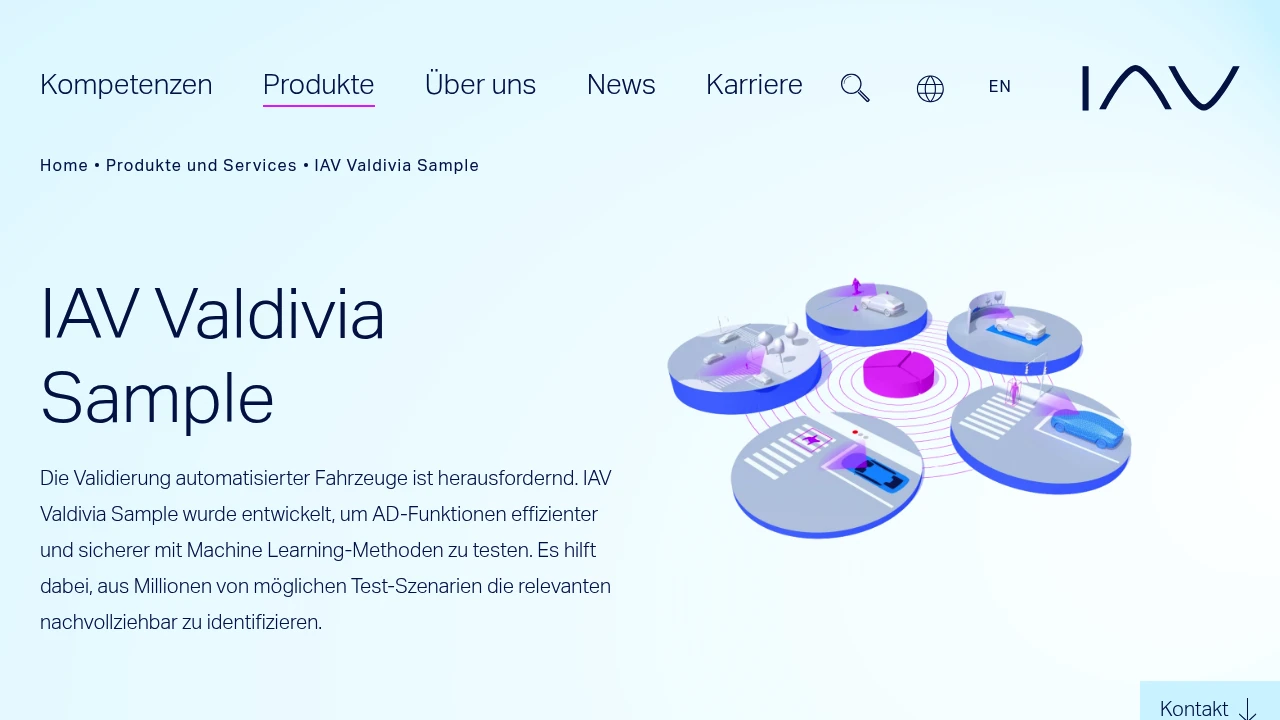
The validation of automated vehicles presents significant challenges. IAV Valdivia Sample is engineered to test AD functions more efficiently and safely through Machine Learning methods. It assists in the comprehensible identification of relevant test scenarios from millions of potential ones.
Automated vehicles must master countless scenarios safely. However, given the vast number of potential situations, testing all of them is not feasible. This is where IAV Valdivia Sample comes in. This software tool supports the targeted selection of test scenarios and helps reliably test automated driving functions in the ADAS and AD domains. This approach can lead to savings of up to 80% in testing effort (exemplary calculation based on research findings).
How do you benefit?
- Generate traceable results: IAV Valdivia Sample employs a scientifically sound approach with state-of-the-art probabilistic ML models, offering a transparent process and traceable decisions.
- Save time and reduce costs: The software can reduce your testing effort by up to 80% through fewer simulations, reduced computation time, and fewer required licenses, leading to increased efficiency and cost savings.
- Start easily, whether in the cloud or locally! IAV Valdivia Sample is designed for integration into fully automated test environments (SiL or HiL) via REST APIs. The solution is cloud-ready and can be used as Software as a Service.
- Countless use cases for numerous industries: Originally designed for AD applications, the tool can be deployed wherever efficient modeling methods are needed for the development or approval of complex systems, such as in the energy or aviation industries.
How does it work?
IAV has developed IAV Valdivia Sample, software that utilizes statistical techniques and artificial intelligence to generate test scenarios. This process is iterative and adapts independently to the previously unknown system and its characteristics, as every system has its own weaknesses that need to be uncovered.
- Generate diverse scenarios: Test scenarios are initially generated using statistical techniques to achieve broad coverage and consider a wide range of situations.
- AI comes into play: The results of these tests are then analyzed using AI to identify which scenario characteristics, alone or in combination, favor critical outcomes. This could be, for example, the interplay of low sun and a wet road.
- Iterative improvement for better understanding: Finally, critical scenarios for the system are iteratively generated, and their data is analyzed again. With each iteration, more weaknesses can be uncovered, leading to a better understanding of the system.
Using artificial intelligence, this method goes beyond traditional optimization and experimental design procedures. It is characterized by the use of probabilistic metamodels and repeated, adaptive experimental planning (Adaptive Importance Sampling). Probabilistic models ultimately allow for the calculation of probabilities for critical scenarios, providing a measurable basis for the release decision of safety-critical systems.

Similar to IAV Valdivia
 Car0 — Tools for modern automotive engineers


