
AVL Model.CONNECT
Connects disparate simulation tools and models, enabling integrated system simulation for early error detection and cost reduction in vehicle development
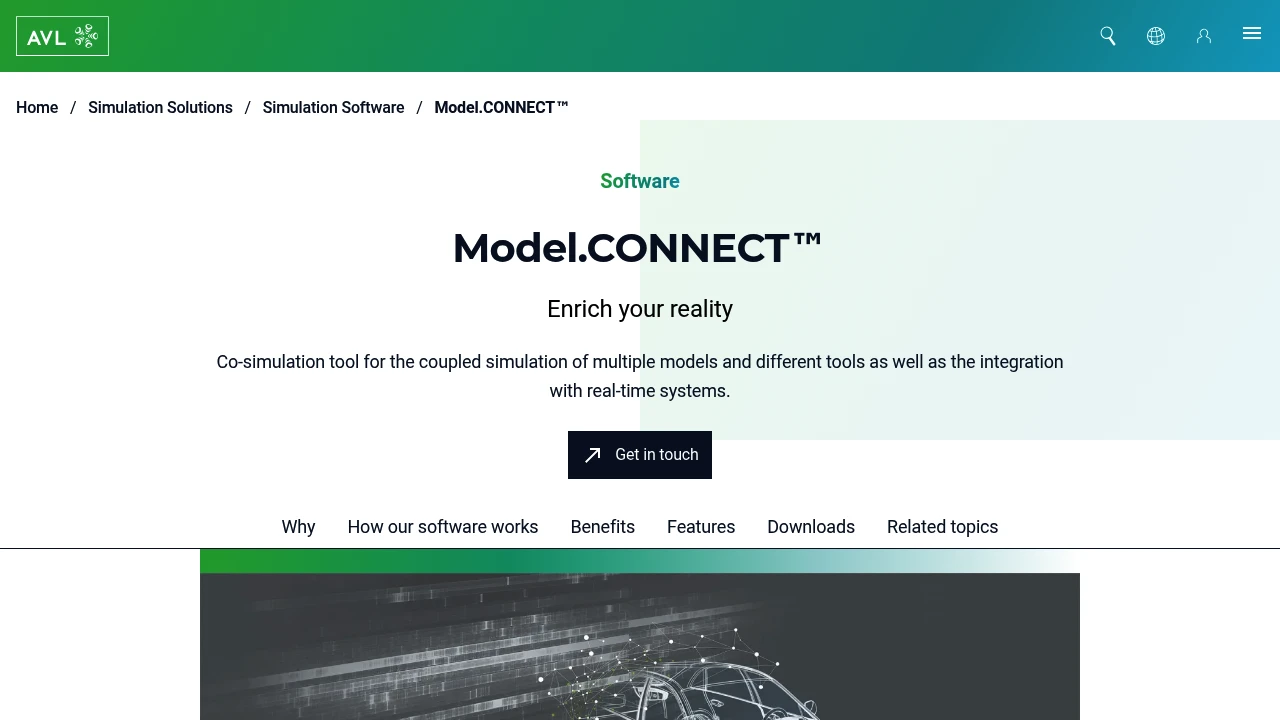
In today's vehicle development, interconnectedness is key. Components are no longer isolated, requiring cross-departmental collaboration. This often leads to conflicts between different modeling strategies and tools. Model.CONNECT™ bridges this gap, facilitating the coupling of any simulation tool through intuitive interfaces. This allows for the integration and coupled simulation of diverse models and tools into a comprehensive system.
Addressing the exponential cost increase of design errors throughout a project, Model.CONNECT™ enables early testing of subsystems within the vehicle context, identifying errors sooner and preventing cost escalation. It tackles the challenge of components developed by different teams, often using separate tools or external suppliers. With easy-to-use interfaces to leading simulation tools and open interfaces for custom integration, it ensures that even when co-simulation models are distributed across companies, collaboration is possible without model exchange, protecting sensitive data.
Key Benefits:
- Verification: Confirm design decisions early and across teams using virtual prototypes.
- Reduce Costs: Avoid cost escalation through virtualization and frontloading of integration tests.
- Sustainability: Minimize physical prototypes with mixed-reality approaches.
- Collaboration: Foster cross-functional teamwork.
Model.CONNECT™ couples different simulation tools and models, analyzing them and displaying input/output signals. Connections can be made manually or automatically via a wizard or APIs. It offers multiple coupling mechanisms and co-simulation engines for optimal integration flexibility and performance, with patented signal stabilization algorithms enhancing results. The job management system supports local or cloud-based sequential and parallel execution. Global parameter variations for optimization are easily performed. Extensive scripting support enables automation and integration into CI/CD pipelines.
Features:
- Flexible Interfaces: Over 30 interfaces to industry-leading simulation tools, including custom UI and real-time support.
- High Performance: A top-tier co-simulation engine with patented signal stabilization.
- Fully Automated: Comprehensive scripting for test automation, toolchain integration, and result analysis.
- Collaboration: Enhances result sharing across departments.
- Coupling: Reliable synchronization of signal values, even with differing solver frequencies.
- Standards: Active involvement in standardization committees (Modelica, ASAM) and implementation of standards like FMI, SSP, XCP.
User-Friendly Setup: Drag-and-drop interfaces simplify co-simulation topology setup. The software captures ports, and connections can be made manually or automatically, with data type and unit checking/conversion.
Global Parameter Management: Consolidates parameters from individual models, allowing manual or automatic test case creation and Python-based parameter scripting.
Optimization and Job Management: Supports sequential/parallel execution locally or in the cloud, with over 15 optimization algorithms and external tool interfaces.
Interactive Performance Analysis: Live signal monitoring and performance analysis help identify bottlenecks and optimize system performance.
Similar to AVL Model.CONNECT
 Car0 — Tools for modern automotive engineers


